Mostrando entradas con la etiqueta ausangatetrek. Mostrar todas las entradas

miércoles, 4 de marzo de 2020

AUSANGATE AND SIBINACOCHA LAGOON INFORMATION


DAY 1: CUSCO - OCONGATE - TINKI COMMUNITY
We leave the city of Cusco in a private transport, in the direction of Tinki (3800m/12464ft). On the way we stop in Urcos, where we may visit a beautiful lake with the same name. We then go on to Cattca, where we can appreciate the region’s spectacular views and finally pass through Ocongate, capital of the district with the same name and only half an hour away from our destination. After an approximated of 6-hour drive, we arrive at Tinki, Tinki will be our first campsite and start the trek the next morning.
DAY 2: TINKI - PACCHANTA - QOMERQOCHA LAGOON
After breakfast, we will spend some time visiting the Tinki public school and will have the chance to meet the children of the neighboring communities that study at this place. Then We then leave Tinki and start a 2,5h walk towards Pacchanta (4100m/13448ft), where we stop for lunch. Pacchanta is a rural community that boasts some well-known hot springs where we can enjoy a nice dip, offering awesome views of Ausangate Mountain. In the afternoon we follow our trek through a slight climb up the Pacchanta valley, having the chance to spot llamas and alpacas, until we reach the beautiful Qomercocha lagoon where we set our camp and have dinner. Our campsite will be set in a spectacular spot with amazing views of Ausangate.
DAY 3: QOMERQOCHA LAGOON TO YANAMAYO
We leave Qomercocha lagoon around at 7.00 am and continue on towards the first mountain pass of our trek, the Abra Q´ampa at 5000m/16400ft, which we will reach after about 4h. then We will descend towards the Ticllaqocha Lagoons, a beautiful group of little turquoise lagoons next to which we have lunch. In the afternoon we continue our hike for an additional 2-3h until we reach Yanamayo where we set our camp in an impressive valley overlooked by the impressive Tres Picos.
DAY 4: YANAMAYO TO CONDORPASO
We leave camp and start a gradual climb up toward Yanaqocha or “Black Lagoon” its name being due to the dark color of its waters. We will go over Yanaqocha mountain pass (5050m/16564ft) to then discover a surprisingly beautiful valley with an explosion of colored mountains, three spectacular lagoons and the presence of llamas and alpacas, which we will cross to head towards our next mountain pass (5100m/16728ft). From this point, an additional hour of hike leads us to Condor pass, our next campsite, located very close to the mountain pass of the same name which will be our challenge for the next day.
DAY 5: CONDOR PASS TO SOURCE OF SIBINACOCHA LAGOON
After breakfast, we continue on a gradual climb up the valley that takes us to the mountain pass Abra del Condor (5200m/17056ft) after an approximated two hour walk. We have spectacular views of the Vilcanota mountain range and the Sibinacocha Lagoon, our next milestone, where can see wild vicuñas. Immediately. we continue our hike for 3 hours, crossing another mountain pass on the way and then descending into the valley of the Sibinacocha Lagoon’s source. We will camp next to the lagoon and very close from its source. The lagoon boasts a wide bio-diversity, where we can see Andean Coots, “Huallatas” or Andean Geese as well as Andean Ducks from our camp.
DAY 6: SOURCE OF SIBINACOCHA LAGOON TO CCASCANA
Today, we depart early to walk along the shores of the Sibinacocha Lagoon for 3h until we reach the Yayamari community, (5500m/18040ft). We then continue accross a pampa where we will most probably see hundreds of llamas, alpacas and hopefully vicuñas, to then follow towards the Abra Ccascana at 5000m/16400ft, which will lead us to the lagoon of the same name, in where we will set our last camp and we may have the chance to spot ¨Huallatas¨ or Andean geese and maybe even flamingos.
DAY 7: CCASCARA TO PHINAYA VILLAGE AND BACK TO CUSCO
After our breakfast, we leave Ccascara to walk for 3 and 30 minutes towards Phinaya. This is a small Andean community with a beautiful little church, where we will have lunch. In the afternoon, we meet our private transport that will drive us back to Cusco, where we expect to arrive after nightfall.
AUSANGATE TREK INFORMATION

jueves, 12 de septiembre de 2019

AUSANGATE TREK ROUTE INFORMATION

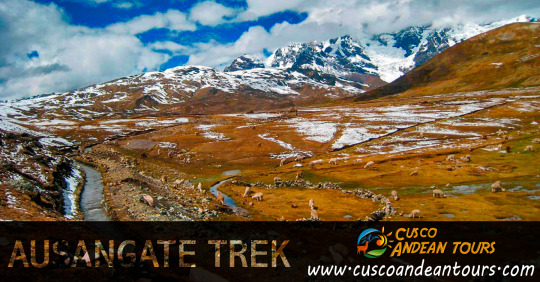
Guardian of the Cusco region, Ausangate is the fifth highest mountain in Peru with its 6,384 meters high. For centuries it has received many names, the best known being ‘The Roof of the Inca Capital’ and ‘Vinicunca’, which means ‘Cerro de Colores’.


Located in the district of Pitumarca (in the province of Canchis –region of Cusco-, in the south of the country), Ausangate is considered the most important mountain in the Andean worldview. And although it is also one of the most beautiful is one of the least known abroad, always overshadowed by that impressive ‘Wonder of the World’ called Machu Picchu.
AUSANGATE TREK PACKAGES:
Ausangate Trek 5 Days
Ausangate Circuit 7 Days
A walk through these parts constitutes a very special experience, combining the fact of being at such levels with the enjoyment of an outdoor activity and the contemplation of a visual wonder.
How to get? Ausangate is the fifth highest mountain in Peru, its maximum altitude is 6,372 meters above sea level. It is located about 100 kilometers southeast of the city of Cusco. You leave the city in a vehicle, the estimated travel time is 3 hours, when you arrive in Chilca, the 3-hour walk begins towards the mountain of colors (you walk about 4 km ½ approx.). It can be done in a private car or by hiring a tour.
The road to Ausangate is one of the most amazing experiences you can have, enjoy the scenery, be accompanied by birds and native animals during the road is only part of all that this great opportunity offers, you can find yourself, where you will receive the protection and wisdom of what was once sacred to our culture.

martes, 20 de agosto de 2019

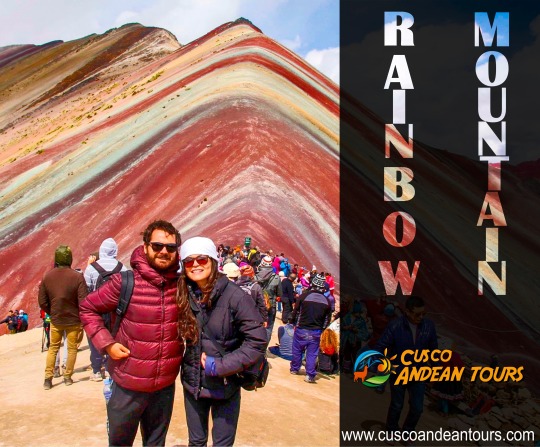
RAINBOW MOUNTAIN INFORMATION

About 100 kilometers southeast of Cusco, Peru, there is a rainbow mountain.


It is the mountain of the Seven Colors, also known as Vinicunca or Rainbow.
The pilgrimage in the Peruvian Andes in search of the Snow Star
The mountain is located in the Vilcanota Range at 5,200 meters above sea level, in the Pitumarca district.
Its slopes and summits are dyed by stripes of intense shades of fuchsia, turquoise, lavender and gold.
The visual show offered by Vinicunca has attracted visitors since the beginning of 2016, according to Haydee Pacheco, a tourism official at the Municipality of Pitumarca.
In just over two years, travelers who take pictures with the summit went from a few tens to about 1,000 a day, say Peruvian media, despite the cold and altitude of the place.
Thanks to its popularity, also driven by social networks, the hill became a common destination in the rankings of tourist attractions in the world.
For example, in August 2017, it appeared on the list of 100 places to visit before dying recommended by travel experts on the Business Insider website.
The tourist boom is quite recent, but the history of the mountain and its colors began millions of years ago.
Minerals
The rainbow aspect of Vinicunca is due to "a complex geological history of marine, lake and river sediments," according to a report by the Office of Cultural Landscape of the Decentralized Directorate of Culture of Cusco.
10 rock formations of unsurpassed beauty
These sediments, transported by the water that previously covered the area, date between the tertiary and quaternary periods, that is, from about 65 to two million years ago.
Over time, the sediments were forming layers (with different grain sizes) that today look like the stripes that attract tourists so much.
The movement of tectonic plates in the area raised these sediments until they became mountains.
5 tourist destinations threatened by excess visitors (and two are in Latin America)
Then they acquired their striking colors because of the oxidation of their minerals, exerted by the humidity of the area, and their erosion, explains César Muñoz, a member of the Geological Society of Peru (SGP),
Muñoz and the study of the Office of Cultural Landscape detail the composition of each strip according to its color.
Pink or fuchsia: mixture of red clay, fangolites (mud) and sand.
Off-white: sandstone (quartz sand) and limestone.
Purple or lavender: marl (mixture of clay and calcium carbonate) and silicates.
Red: argillites and clays.
Green: clays rich in magnesium ferro (mixture of iron and magnesium) and copper oxide.
Yellowish, mustard or golden brown: limonites, calcareous sandstones rich in sulphide minerals (combined with sulfur).

miércoles, 6 de marzo de 2019

AUSANGATE AND SIBINACOCHA LAGOON

AUSANGATE TREK PHOTO

DAY 1: CUSCO - OCONGATE - TINKI COMMUNITY
We leave the city of Cusco in a private transport, in the direction of Tinki (3800m/12464ft). On the way we stop in Urcos, where we may visit a beautiful lake with the same name. We then go on to Cattca, where we can appreciate the region’s spectacular views and finally pass through Ocongate, capital of the district with the same name and only half an hour away from our destination. After an approximated of 6-hour drive, we arrive at Tinki, Tinki will be our first campsite and start the trek the next morning.
DAY 2: TINKI - PACCHANTA - QOMERQOCHA LAGOON
After breakfast, we will spend some time visiting the Tinki public school and will have the chance to meet the children of the neighboring communities that study at this place. Then We then leave Tinki and start a 2,5h walk towards Pacchanta (4100m/13448ft), where we stop for lunch. Pacchanta is a rural community that boasts some well-known hot springs where we can enjoy a nice dip, offering awesome views of Ausangate Mountain. In the afternoon we follow our trek through a slight climb up the Pacchanta valley, having the chance to spot llamas and alpacas, until we reach the beautiful Qomercocha lagoon where we set our camp and have dinner. Our campsite will be set in a spectacular spot with amazing views of Ausangate.
DAY 3: QOMERQOCHA LAGOON TO YANAMAYO
We leave Qomercocha lagoon around at 7.00 am and continue on towards the first mountain pass of our trek, the Abra Q´ampa at 5000m/16400ft, which we will reach after about 4h. then We will descend towards the Ticllaqocha Lagoons, a beautiful group of little turquoise lagoons next to which we have lunch. In the afternoon we continue our hike for an additional 2-3h until we reach Yanamayo where we set our camp in an impressive valley overlooked by the impressive Tres Picos.
DAY 4: YANAMAYO TO CONDORPASO
We leave camp and start a gradual climb up toward Yanaqocha or “Black Lagoon” its name being due to the dark color of its waters. We will go over Yanaqocha mountain pass (5050m/16564ft) to then discover a surprisingly beautiful valley with an explosion of colored mountains, three spectacular lagoons and the presence of llamas and alpacas, which we will cross to head towards our next mountain pass (5100m/16728ft). From this point, an additional hour of hike leads us to Condor pass, our next campsite, located very close to the mountain pass of the same name which will be our challenge for the next day.
DAY 5: CONDOR PASS TO SOURCE OF SIBINACOCHA LAGOON
After breakfast, we continue on a gradual climb up the valley that takes us to the mountain pass Abra del Condor (5200m/17056ft) after an approximated two hour walk. We have spectacular views of the Vilcanota mountain range and the Sibinacocha Lagoon, our next milestone, where can see wild vicuñas. Immediately. we continue our hike for 3 hours, crossing another mountain pass on the way and then descending into the valley of the Sibinacocha Lagoon’s source. We will camp next to the lagoon and very close from its source. The lagoon boasts a wide bio-diversity, where we can see Andean Coots, “Huallatas” or Andean Geese as well as Andean Ducks from our camp.
DAY 6: SOURCE OF SIBINACOCHA LAGOON TO CCASCANA
Today, we depart early to walk along the shores of the Sibinacocha Lagoon for 3h until we reach the Yayamari community, (5500m/18040ft). We then continue accross a pampa where we will most probably see hundreds of llamas, alpacas and hopefully vicuñas, to then follow towards the Abra Ccascana at 5000m/16400ft, which will lead us to the lagoon of the same name, in where we will set our last camp and we may have the chance to spot ¨Huallatas¨ or Andean geese and maybe even flamingos.
DAY 7: CCASCARA TO PHINAYA VILLAGE AND BACK TO CUSCO
After our breakfast, we leave Ccascara to walk for 3 and 30 minutes towards Phinaya. This is a small Andean community with a beautiful little church, where we will have lunch. In the afternoon, we meet our private transport that will drive us back to Cusco, where we expect to arrive after nightfall.

martes, 5 de marzo de 2019

AUSANGATE TREK


Ausangate Trek 5 days, will take you Ausangate mountain itself is considered a holy mountain by local people and is the deity of Cusco. Since pre-Inca times the mountain has been a place of worship and offerings and this tradition continues today.

lunes, 4 de marzo de 2019

RAINBOW MOUNTAIN CUSCO


On Rainbow Mountain Hike, you will see quaint villages, beautiful adobe style houses, herds of llamas and alpacas and you will have magnificent views of the Ausangate Glacier (6,385 m / 20,945 ft), the highest mountain in the Cusco region.

sábado, 2 de marzo de 2019

RAINBOW MOUNTAIN AUSANGATE


The Rainbow Mountain (Vinicunca), are stunning and can be seen on the spectacular Ausangate Trek. Ausangate mountain itself is considered a holy mountain by local people and is the deity of Cusco. Since pre-Inca times the mountain has been a place of worship and offerings and this tradition continues today.