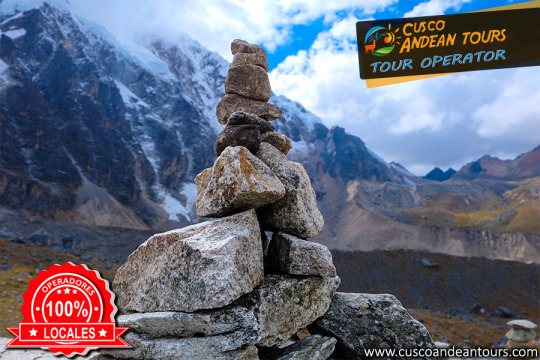
The Salkantay or Salcantay (6,271 m.a.s.l.) is a snowy mountain belonging to the Vilcabamba mountain range. It is the second highest mountain in Cusco after Ausangate (6,384 m.a.s.l.) Its name means wild mountain. Due to its imposing and isolated appearance, it was highly appreciated by the Incas. They put the name ‘Apu’ which means ‘lord’ or ‘sacred’. This snowy mountain was considered one of the most powerful in the region. They worshiped it to the point that they built Machu Picchu in view of its summit. According to the Andean worldview, mountains provided life and decided planting, harvesting and even natural disasters. Because of this, respect and offerings should be given to him. Today, the inhabitants of the Andes continue to consider the mountains as spirits of importance. In Cusco, Salkantay is held in as much esteem as the Incas did. SALKANTAY TREK ROUTE TO MACHU PICCHU INFORMATION
General information
Name: Salkantay Trek.
Kilometers: 72 kilometers approximately.
Climate: minimum of less than 0 ° C in the ‘Abra Salcantay’.
Maximum height: 4,572 m.a.s.l. in the ‘Abra Salcantay’.
Minimum height: 1,800 m.a.s.l. in the town of Santa Teresa.
Difficulty: challenging.
How to do it ?: with a tour or on your own.
When to do it ?: in the dry season (April to October).
Places it covers: Mollepata, Soraypampa, ‘Abra Salkantay’, Chaullay, Santa Teresa, Aguas Calientes and Machu Picchu.
Physical conditions: it is recommended to be in good physical condition.
Recommendations:
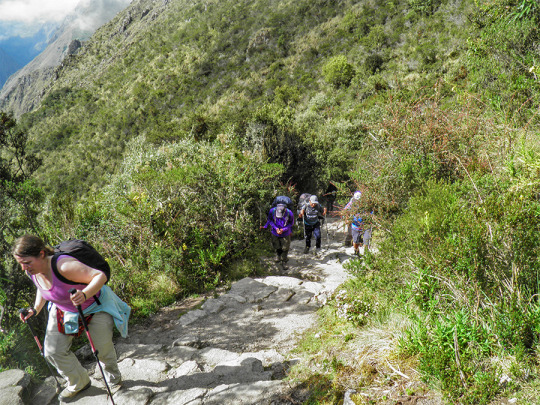
The Salkantay trek is the main hiking alternative to the Inca Trail. More and more tourists are encouraged to arrive at Machu Picchu through this 5-day and 4-night trek through amazing landscapes such as the snowy Salcantay. To fully enjoy this adventure, take into account the following recommendations:
It is possible to do this trek on your own or with a tour. Due to the difficulty of the adventure, it is recommended to do it with a tourism agency. Otherwise, you must have experience in mountaineering.
Perhaps the main drawback to this adventure is the "soroche" or altitude sickness. It is advisable to do a previous acclimatization in the city of Cusco.
Most tourism agencies include the main implements such as tents, food and guide. In case of doing it independently, it is recommended to take everything you need.
The cold at the foot of the snowy Salkantay is perhaps another of the main difficulties. It is recommended to wear thermal clothing.
The rainy season (from October to March) is characterized by the highest probability of river precipitation. It is not a good climate for trekking.
In case you do it on your own, do not forget to book the Machu Picchu Ticket in advance. It is the only way to know the Wonder of the World
The Inca Trail to Machu Picchu has a significant number of Archaeological Sites, distributed along the route.
Llactapata
Qoriwayrachina
Paucarcancha
Warmiwañuska
Runkurakay
Sayaqmarka
Phuyupatamarka
Wiñaywayna
Intipata
Intipunku
Inca bridges on the Inca Trail
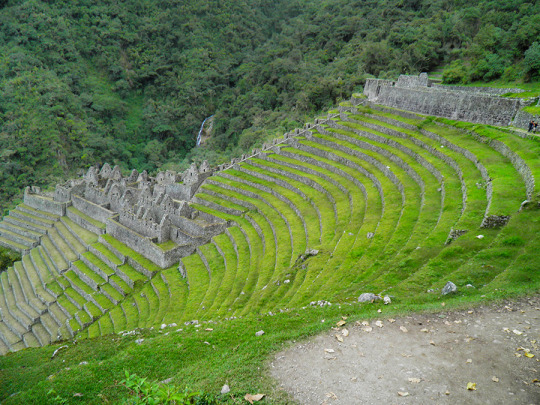
An important site on the route is Wiñaywayna - "Eternamente Joven", it is an archaeological site belonging to the Inca period, built by the Inca Pachacutec, the maximum representative of the Inca Culture, known as the architect of the Inca period. The name corresponds to an orchid that abounds in the place. Wiñaywayna is 2,650 m away. / 8,694 ft. 5 km southeast of the main Llaqta of Machu Picchu. This architectural complex of Wiñaywayna, corresponds to the plan of a small town, are a group of houses grouped together, in a single courtyard, in the manner of the current condominiums. The possible dwelling areas have trapezoidal-style niches and door openings with a single jamb. The monument is surrounded by platforms of different sizes, which responded to the function, either for agriculture or containment to prevent soil erosion. You can notice the structures, the gables for the thatched roofs that were fastened with rings. Likewise, the set of liturgical sources stand out, on a strongly sloped surface, the entire small city is made of granite rock and seen from a high part, clearly, we can notice that it has the same architectural distribution as Machu Picchu. From this place the Inca Trail, is shown almost horizontal, the path gets smoother, they rise up by long stairs that bring us closer to Inti Punku, the entrance door to Machu Picchu. INCA TRAIL TO MACHU PICCHU INFORMATION
The imperial city of Cusco capital of the province of the same name (Cusco). Cusco is an immense magnetism for national and foreign tourists who visit us and come to this mythical center, full of mystery and enigmas. In the city, history and modernity have been combined quite well, essential factors that promote tourism. At all times of the year it is possible to find accommodation, enjoy good food available to all, and tour the different tourist circuits.
The city of Cusco, located in the legendary Huatanay Valley, at 3,350 meters above sea level, has been inhabited since time immemorial. It is considered the oldest city in the American continent. There was Qosqo, the "navel of the world", the capital of Tahuantinsuyo, the Inca Empire. Already in colonial times it became the capital of the Viceroyalty of Peru, and after the independence of the country originated the first prefecture of the newly born Republic.
Nowadays, it offers its visitors a variety of natural and cultural attractions. Its excellent Andean climate makes it easy to walk through the cobbled streets and get to know the city in the best possible way, strolling, strolling through its Plaza de Armas, the Cathedral, the Church of El Triunfo, the Compañía de Jesús (16th century), built on the ancient palace of the Inca Huayna Capac), the churches of San Blas or La Merced, or visiting its many museums.
In the surroundings of Cuzco, the Sacred Valley of the Incas and the Machu Picchu, which receives more and more tourists, stand out for their interest.
Machu Picchu,This stunning site situated on a mountain ridge above the Sacred Valley is the best-preserved relic of Inca civilisation and South America’s most popular attraction with an estimated 3,000 people visiting on a typical day.