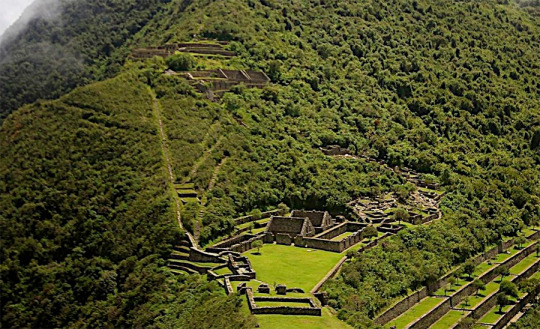
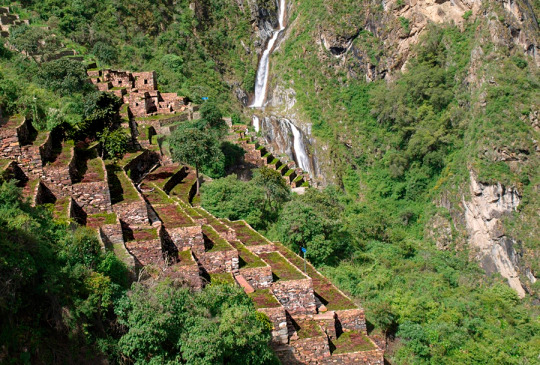
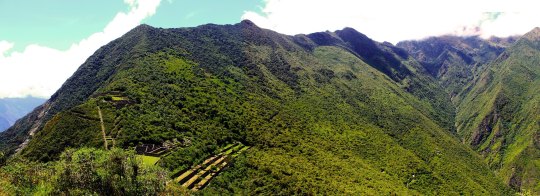
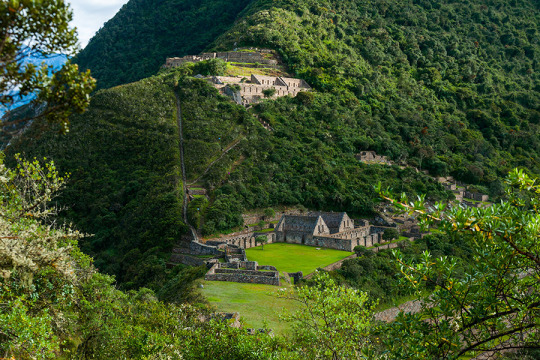
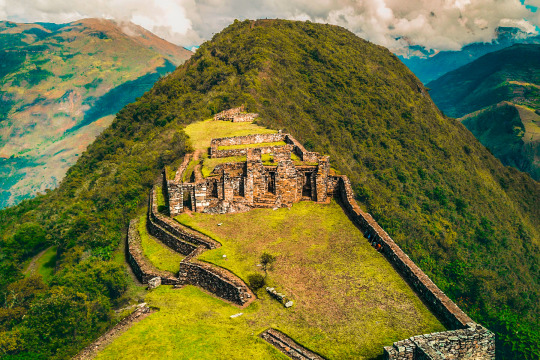
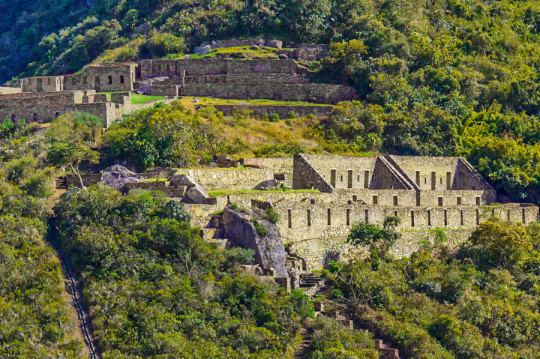
Also known as the sacred sister of Machu Picchu, Choquequirao (which means “Cradle of Gold”) is today the archaeological complex of an ancient, remote and spectacular Inca city, which takes place at the junction of three important rivers and the Salcantay mountain. behind their backs. MORE INFORMATION OF CHOQUEQUIRAO TREK Archeologists estimate that the city has been explored and cleaned between 30% and 40%, estimating that it far exceeds the famous Machu Pichu in size. Chosen by travelers who prefer to avoid the large masses of tourists, or by lovers of hiking and unspoilt nature, this ancient Inca city in southern Peru offers anyone who is encouraged to visit it an unforgettable and unforgettable experience. .
Below you will be able to find the necessary information so that you do not stop adding Choquequirao to the list of places to visit as soon as possible:
How to get to the old city?
To get to Choquequirao it is necessary to take a four-day (preferably guided) walk. In case of doing it on your own, you have to go first to the small town of Cachora.
You can take a bus from Cusco, on a trip that takes about five hours and from this place you can rent mules and a guide, and in this way save a few dollars, which are the ones charged by the tourism agencies that sell the different excursions. The 4-day walk to make the round trip is 3 times more difficult than the famous Inca Trail, and also requires camping or sleeping in one of the towns that serve as stops.
Once there, you must pay the entrance to the park, which costs 60 soles for adults (about $ 18) and 30 soles for minors or students ($ 9). CHOQUEQUIRAO TREK INFORMATION
Choquequirao is as impressive as Machu Picchu? This ancient Inca city is known as the younger sister of the Wonder of the World. Some tourists who made the 2-day hike to visit it even say that Choquequirao is better. It is true? Learn the truth about this new archaeological site in Cusco, Peru.
MORE INFORMATION OF CHOQUEQUIRAO TO MACHU PICCHU
What is Choquequirao really?
Choquequirao is an Inca urban center with features common to others in Cusco, especially Machu Picchu.
The similarity with Machu Picchu is largely due to the similarity of the geography of the place where the enclosure was built.
According to various investigations, Choquequirao would also be a fortress and a ceremonial center. The truth is that due to its hidden location in a high and distant mountain; It was a strategic point for various purposes.
Over the years, like Machu Picchu, Choquequirao was abandoned and covered by the jungle until its re-discovery.
Unlike Machu Picchu, there is no train or bus to get to Choquequirao. The only way is to do it on foot through 32 kilometers of incredible landscapes.
Day 1: Cusco - Cachora - Playa Rosalina - Santa Rosa
We will pick up you from your Hotel at 5.00 am in our private transport and drive towards Cachora (4 hours approx.) the starting point of the trek where we meet our horsemen and horses. Then we start our hike climbing for 2 hours approx. to Capuliyoc where may we enjoy beautiful views of the surrounding mountains. We continue after Capuliyoc, descending for two more hours to Chiquisca and our delicious lunch made by our chef. After lunch we keep going down the mountain until we reach Playa Rosalina campsite. After crossing the Apurimac River we start the climb to Santa Rosa, zigzagging up a steep slope (2 hours approx.) where those who wish may try Cambray the “typical drink” here, made locally from a sugar cane extract. Day 2: Santa Rosa - Archaeological Site of Choquequirao
We will wake up for breakfast and so we can have an early departure from Santa Rosa. Afterwards, we continue our hike slowly climbing for 2 hours approx to Marampata.
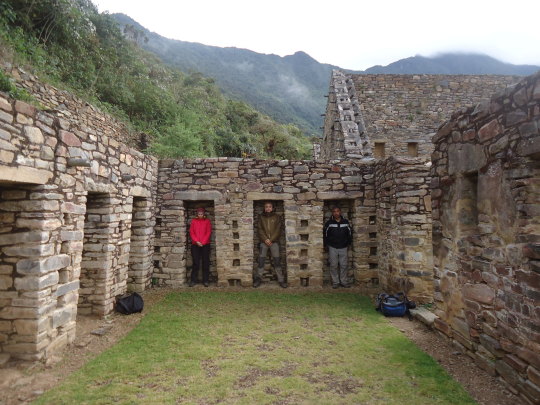
Then we continue to enjoy this day we will dedicate ourselves exclusively to enjoying all the magic of history and splendor of Choquequirao, we will enjoy a complete guided tour of the Choquequirao complex, including a visit to the high parts (Hanan), and the lower parts (Urin). There will be time to know explore the site with its 8 sectors, its barns, houses and temples. You will see the three stages of the excavation of this late Inca-town: the excavated buildings and constructions; the ruins currently in the process of excavation and finally the unexplored areas and terraces with the secrets they may hold of this last refuge of the dying Inca empire. And throughout the day we will keep an eye to the sky for a glimpse of the majestic flight of condors. With luck on the high steep slopes of Chocuequirao, they can pass very close to you. We will enjoy our lunch and then we will return to our Maranpata campsite for rest. Day 3: Choquequirao - Playa Rosalina - Chiquisca
This morning we enjoy our delicious breakfast and start our 1 ½ hour walk back towards Maranpata and a descent to Playa Rosalina for lunch and a some relaxation time. After lunch we climb for 2 hours to Chiquisca campsite where dinner will be waiting for us.
In Chiquisca you can have a shower and eat some exotic local fruits from this area. Day 4: Chiquiska - Cachora - Cusco
We leave camp after breakfast to start the two to three hours climb to Abra Capuliyoc. We will leave Chiquisca campsite early because the sun can be very strong after 10 am, so we plan to to arrive at Capuliyoc by then. Then it is an easy two hours more back to Cachora where we have our lunch. In the afternoon, we met our private transport which will be waiting to take us back to Cusco. Estimated arrival time around 5.00pm.
It is located at 13 ° 32 'south latitude and 72 ° 44' west longitude. It is located at 3035 m.a.s.l. in the foothills of the snowy Salcantay, north of the Apurimac river valley, in the province of La Convencion in the department of Cusco. It is approximately at a distance of 47 km. with reference to the town of Cachora (department of Apurimac).
We can mention that the Choquequirao environment is one of the richest in biodiversity. All these species have been conditioned despite temperature variations such as sun throughout the day and inclement frosts during the night. The fauna of the place is mainly composed of condors, tarucas, vizcachas, foxes, skunks, pumas, hummingbirds, spectacled bears and the popular rock cock, the national bird of Peru. Giant ferns, ichu and a great variety of orchids stand out in its flora, where the wakanki variety stands out. CLASSIC CHOQUEQUIRAO TREK INFORMATION
Weather
Because of its geographical position, Choquequirao has a warm climate alternated with cold temperatures at night. The average annual temperature is 17ºC.
History
During the Inca civilization it was a cultural as well as religious center for the region. Well, it is presumed that this citadel was used as a checkpoint to ensure access to the areas of Vilcabamba, which connected the jungle with other important centers such as Písac and Machu Picchu. It is also estimated that the citadel played an important role serving as a link between the Amazon rainforest and the capital of the Inca empire (Cusco).
At the time of transition that lasted approximately 40 years, Choquequirao is considered one of the last strongholds of resistance and refuge of the Incas, who by orders of Manco Inca, left the city of Cusco to protect themselves in the cities of the Vilcabamba region, when around 1535 Cusco was controlled by the Spanish. It was in this place (and in general throughout the Vilcabamba Valley) where Manco Inca and the last Inca descendants of Vilcabamba where they resisted the attack of the Spaniards, until the capture and execution of Túpac Amaru I that happened in the year 1572.
Biodiversity
The environment of Choquequirao is one of the richest in biodiversity, biologists, ecologists and experts mention it, however in this area, it is not known exactly the number of species in plants and animals that exist, despite this deficiency and From the few scientific studies carried out, it has been possible to determine the existence of various life forms.
Among the most relevant species are: Al condor, the fox, the skunk, the puma, the spectacled bear, the taruca, the vizcachas, the pica flowers, the tall toucan, the quetzales and the tigrillos. All these species have been conditioned despite temperature variations such as the sun throughout the day and the frosty during the night. This space can also be seen to the cock of the rocks, national bird of Peru.
The flora of the place is composed of giant ferns and a great variety of orchids, where the wakanki variety stands out. At the bottom of the great valley and under the thermal effect of the watercourse that runs through it, the forests of the mountain eyebrow provide their warmth and ideal conditions for a huge variety of coca, achiote, corn, cocoa, coffee and fruit crops.
From the environmental point of view, the main value of these presented ecosystems lies in the role played by the lush forests that grow in the high parts of the mountains for the maintenance of the water balance of the region, capturing rainwater and driving it without causing erosion towards the Apurimac river. CHOQUEQUIRAO TREK TO MACHU PICCHU INFORMATION
The Inca history still keeps infinity of secrets. One of them is Choquequirao: the one known as the last Inca bastion and sister citadel of Machu Picchu is still a mystery to researchers in this South American culture.
Choquequirao is located between the jungle and the Peruvian Andes, on a mountain 3033 meters above sea level and has a great peculiarity: it can only be accessed by walking, on a 62 km round trip and with descents and rises from 3100 to 1400 and vice versa.
Is this effort worth it? Without a doubt. Its difficult access makes Choquequirao one of the most charming places in all of Peru: with an almost intact fauna and flora and with less than 25 visitors per day.
How to get to Choquequirao? The easy way (and expensive) is to do it with a tour, which charges you around 300 dollars with everything included. But today we want to talk about the most adventurous and cheap way to visit this citadel: on your own.
Get to San Pedro de Cachora
The starting point of Choquequirao is the small town of San Pedro de Cachora, in the department of Abancay. To get here, you can do it from Cusco or from Lima, via Abancay.
We recommend you spend a night in Cachora to start the hike the next day very early.
From San Pedro de Cachora to the Santa Rosa campsite
The starting point of is the Capullylloc viewpoint, located 7 kilometers from San Pedro de Cachora. Although many people make this stretch walking, we recommend doing it by taxi and thus save energy for the rest of the way.
The first part of the route is a great descent until you reach Playa Rosalina, where there is a camp where you can stay for the night, but if you still have energy, we recommend you simply take a short break and continue to the Santa campsite Pink. From Santa Rosa to Choquequirao
As soon as the first rays of sun come out, it is time to continue with the road and thus we will reach our destination avoiding the hottest moment of the day.
From Santa Rosa to Choquequirao you will go through a long curve and climb road. Before reaching the Inca citadel, you will go through the town of Marampata, where you can stop for lunch and recharge. From this point to Choquequirao it is only about an hour away where you will go through a more jungle area full of different types of butterflies.
Arrival to Choquequirao
Once in Choquequirao you have the option to see the citadel in what you have left during the day or spend the night there, since there is a campsite, and take the next day to explore the construction with more tranquility.
As Choquequirao is not 100% discovered (most buildings still remain under vegetation), the citadel can be traversed quickly. Do not miss the main square and its surroundings and the llamas platforms (the visit to the latter requires extra effort, but it is very worthwhile!)
Tour of San Pedro de Cachora
After enjoying Choquequirao, the return to San Pedro de Cachora you must do it the same way you came. Our advice is that you leave the citadel very early and arrive at the Cocamasana camp. Here you can spend the night and resume the road the next day: you will only have 14 kilometers left to arrive!
Frequent questions
Food: to avoid carrying a lot of weight, we recommend you take only a few snacks (fruit, nuts, etc.) in your backpack. In all campsites you will find families offering food dishes at an economical price. Water: there are different places to buy or recharge your water bottle along the way, yes, if you prefer to refill it, we recommend you take purifying tablets to clean the water. Camping: the campsites on the way to Choquequirao charge around S / 5 for letting you camp there, while the one in the citadel is totally free. Some of them have tents to rent but others do not, so it is advisable to bring your own. Cargo mules: the road to Choquequirao is long and tedious, so if you see that you can not with all the cargo you carry in your backpack you will always have the option to pay a muleteer and take your things in a cargo mule . Of course, this always with responsibility and without burdening the animal in excess. Signaling: the road is perfectly signposted, so the risk of getting lost until reaching Choquequirao is nil. Dates of visit: it is advisable to avoid the visit to Choquequirao between the months of January and March, since it is the rainy season and the soils can be very muddy. Price: the general admission price to Choquequirao is S / 60.
Information of Choquequirao Trek
Day 1: Cusco - Cachora - Playa Rosalina - Santa Rosa
We will pick up you from your Hotel at 5.00 am in our private transport and drive towards Cachora (4 hours approx.) the starting point of the trek where we meet our horsemen and horses. Then we start our hike climbing for 2 hours approx. to Capuliyoc where may we enjoy beautiful views of the surrounding mountains. We continue after Capuliyoc, descending for two more hours to Chiquisca and our delicious lunch made by our chef. After lunch we keep going down the mountain until we reach Playa Rosalina campsite. After crossing the Apurimac River we start the climb to Santa Rosa, zigzagging up a steep slope (2 hours approx.) where those who wish may try Cambray the “typical drink” here, made locally from a sugar cane extract. Day 2: Santa Rosa - Archaeological Site of Choquequirao
We will wake up for breakfast and so we can have an early departure from Santa Rosa. Afterwards, we continue our hike slowly climbing for 2 hours approx to Marampata.
Then we continue to enjoy this day we will dedicate ourselves exclusively to enjoying all the magic of history and splendor of Choquequirao, we will enjoy a complete guided tour of the Choquequirao complex, including a visit to the high parts (Hanan), and the lower parts (Urin). There will be time to know explore the site with its 8 sectors, its barns, houses and temples. You will see the three stages of the excavation of this late Inca-town: the excavated buildings and constructions; the ruins currently in the process of excavation and finally the unexplored areas and terraces with the secrets they may hold of this last refuge of the dying Inca empire. And throughout the day we will keep an eye to the sky for a glimpse of the majestic flight of condors. With luck on the high steep slopes of Chocuequirao, they can pass very close to you. We will enjoy our lunch and then we will return to our Maranpata campsite for rest. Day 3: Choquequirao - Playa Rosalina - Chiquisca
This morning we enjoy our delicious breakfast and start our 1 ½ hour walk back towards Maranpata and a descent to Playa Rosalina for lunch and a some relaxation time. After lunch we climb for 2 hours to Chiquisca campsite where dinner will be waiting for us.
In Chiquisca you can have a shower and eat some exotic local fruits from this area. Day 4: Chiquiska - Cachora - Cusco
We leave camp after breakfast to start the two to three hours climb to Abra Capuliyoc. We will leave Chiquisca campsite early because the sun can be very strong after 10 am, so we plan to to arrive at Capuliyoc by then. Then it is an easy two hours more back to Cachora where we have our lunch. In the afternoon, we met our private transport which will be waiting to take us back to Cusco. Estimated arrival time around 5.00pm.
Machu Picchu,This stunning site situated on a mountain ridge above the Sacred Valley is the best-preserved relic of Inca civilisation and South America’s most popular attraction with an estimated 3,000 people visiting on a typical day.